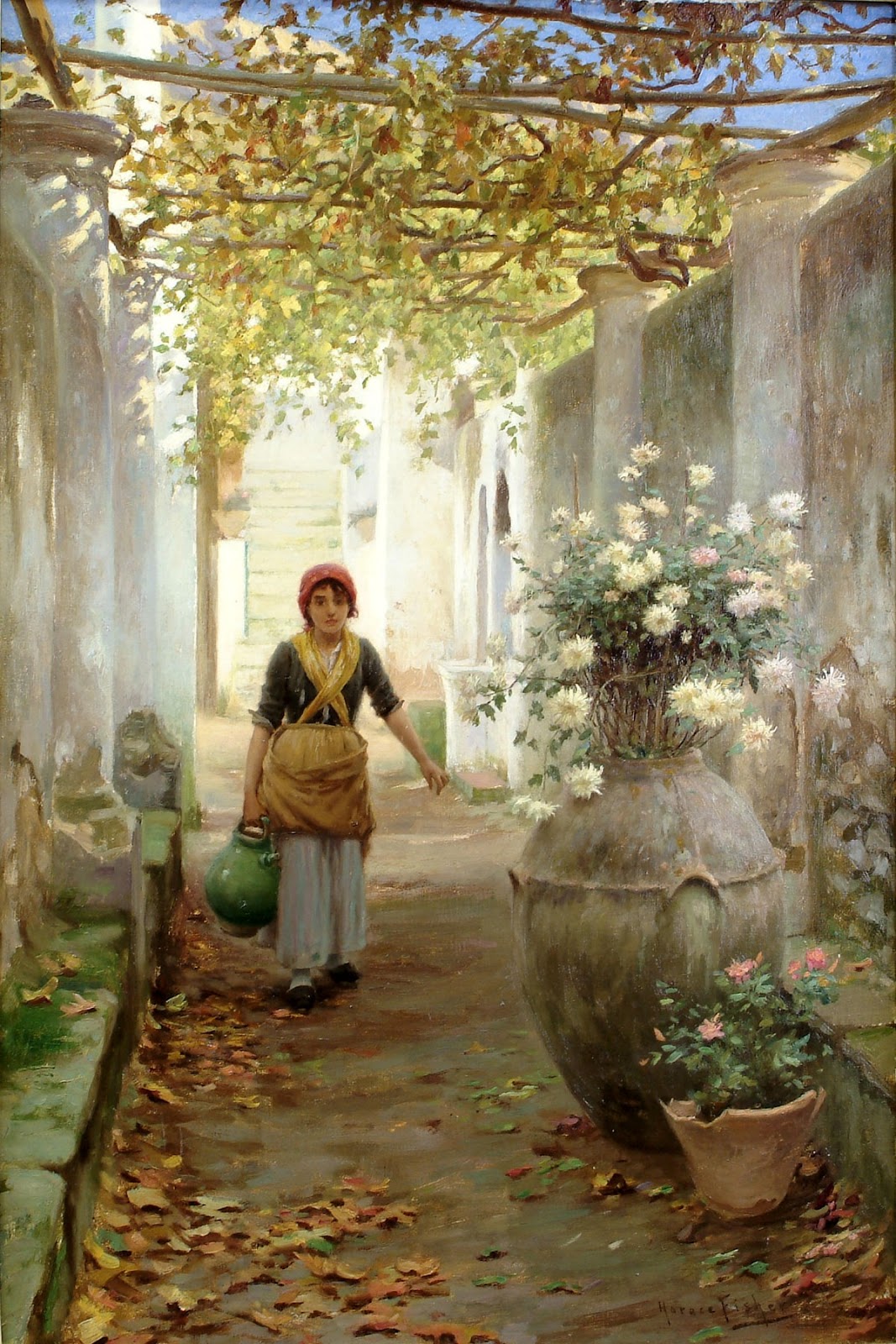
 Horace Fisher (1861–1928) was a notable British genre and portrait painter whose life blended an idyllic artistic expatriate existence in Italy with unique intersections
into social history and LGBTQ+ historical studies. He appears as Francis Cartwright in Compton Mackenzie’s Vestal Fire.
Horace Fisher (1861–1928) was a notable British genre and portrait painter whose life blended an idyllic artistic expatriate existence in Italy with unique intersections
into social history and LGBTQ+ historical studies. He appears as Francis Cartwright in Compton Mackenzie’s Vestal Fire.
After studying at the Royal Academy and winning a medal, Fisher settled in Anacapri in 1887 and year after year sent home Capri scenes for exhibition. ‘Nebulous and
deferential’, as a fellow-Englishman described him, Fisher was glad to escape occasionally from his studio.
Fisher spent more than twenty-five years of his life residing and working in Anacapri, Italy, immersing himself in the vibrant local landscapes,
architecture, and everyday lives of ordinary people. As an artist, he became widely celebrated for his genre paintings—capturing charming scenes of daily Italian life,
rustic courtyards, and intimate interior moments—as well as his striking portraits. His mastery in rendering feminine grace and beauty eventually earned him high critical
acclaim as the stylistic successor to the renowned American illustrator Charles Dana Gibson.
Beyond his canvas work, Fisher's life intersected with broader cultural and social currents, particularly concerning the rigid gender expectations and alternative social
networks of early 20th-century Britain. During the height of the First World War, as aging British expatriates and citizens faced intense social pressure to return home and
contribute to the war effort, Fisher and his contemporary, Godfrey Thornton, found themselves targeted by disapproving
acquaintances who considered it scandalous that they remained abroad. The two aging men were sent postcards aggressively urging them to volunteer for the Front, complete
with the sarcastic promise of a farewell lunch.
This episode highlights intriguing dynamics of queer history and social alienation during the period. Thornton remarked that if he were forced to go to the Front, he
flatly refused to go in the company of Fisher, whom he anticipated would bore him to death. Fisher, conversely, expressed a willingness to "do his bit" if his services were
formally required, but noted that he and Thornton did not see eye-to-eye on "sexual matters," signaling a divergence in their personal lives and orientations that made
Fisher prefer the company of almost anyone else. Through such archival glimpses, Fisher emerges not only as a talented Victorian and Edwardian-era expatriate painter of
sunlit Italian verandas and expressive female subjects, but also as a figure embedded in the nuanced, non-conforming social networks of his era before his death in 1928.
References:
Other references:
- Literary and Satirical Adaptations (Capri Expatriate History): Sir Compton Mackenzie’s novels and semi-fictionalized accounts of the island community (such as Vestal Fire, 1927), which capture the social dynamics, alternative networks, and wartime pressures faced by British expatriates like Horace Fisher and Godfrey Thornton.
- Art Historical and Auction Records: Public art market and catalog documentation establishing Fisher's professional identity, career timeline (1861–1928), genre works, and stylistic standing (including archives from Christie's, Dreweatts, and general fine art indexes tracking his portraits and Italian scenes).
Support this project
This website is a passion project researched, developed, and funded entirely by me. If you find the content valuable and would like to help support the ongoing research and hosting costs, any contribution is deeply appreciated.
Thank you for keeping this independent resource alive!
My books on Amazon: Elisa Rolle's books
BACK TO HOME PAGE
